

Your Budget Is a Strategy Document. Please Read It Like One.
 by Someone Who Actually Read the Assumptions Tab

It is November. The budget has arrived.
It arrived in the board packet on Thursday, which gave everyone the weekend, which everyone used for other things. It is forty-one pages long. It has a cover memo, a summary, a balance sheet projection, an income statement projection, a capital expenditure schedule, a staffing plan, and an appendix that nobody has opened since appendices were invented.
At the meeting, the CFO walks the board through the highlights. The board listens attentively. Then a director asks why the training and travel line went up eleven percent. A second director asks whether the holiday event really needs to be at that venue again. There is a brief and spirited conversation about the cost of branded fleece vests.
Twenty-six minutes later, the budget is approved unanimously.
Somewhere on page nineteen, there was a $1.8 million technology investment that will determine whether the credit union’s digital strategy succeeds or fails over the next three years. Nobody asked about it. It seemed like the kind of thing management had handled.
This is not a story about a careless board. It is a story about a board that reads its budget as an accounting document, when it is actually the most honest strategy document the credit union will produce all year.
The Two-Meeting Problem
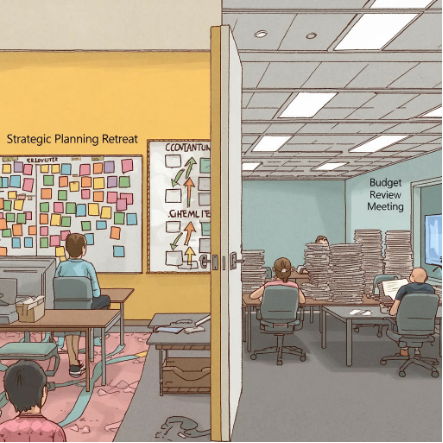
Most credit union boards discuss strategy and money in two different meetings, often months apart, in two different vocabularies.
Strategy happens at the retreat. It is spoken in verbs and aspirations: grow, deepen, transform, serve, become. Everyone is relaxed. There are sticky notes.
The budget happens in the fall. It is spoken in numbers: basis points, FTEs, cost of funds, provision expense. Everyone is in their regular chairs. There are no sticky notes.
Nobody is officially responsible for translating between the two. So the board approves a strategy in September that says the credit union will become the primary financial institution for young families in its market, and approves a budget in November that contains no meaningful money for reaching young families, no new lending products designed for them, and no staff whose job description includes the words “young families.”
Both votes were unanimous. Both votes were sincere. They just weren’t about the same credit union.
Why Boards Read Budgets Backwards
Groups tend to spend the most time on the items they understand best, which tend to be the smallest. (We have written about bikeshedding before. Boards remain committed to it.)
Every director has an opinion about travel expense. Every director has attended a holiday party. Comparatively few directors feel confident challenging the assumptions behind a core processing conversion, a loan growth projection, or a deposit pricing strategy. So the board’s attention distributes itself in inverse proportion to the dollars involved.
The result is a budget review that is thorough about the things that don’t matter and polite about the things that do.
 Management notices this. Management is not foolish. Over time, budget presentations evolve to match the questions the board actually asks, which means more detail on the line items and less discussion of the choices. Nobody designed it this way. It simply happened, one fleece vest at a time.
Reading the Budget for Strategy
Reading a budget strategically does not require a CPA. It requires asking a different set of questions. Here are five worth bringing to your next budget meeting.
Where does each strategic priority show up in dollars? Take the three to five priorities in your strategic plan and find them in the budget. Not in the cover memo. In the numbers. If a priority has no identifiable funding, staffing, or capital allocation, it is not a priority. It is a sentiment.
What did we stop doing to pay for it? A strategy that only adds is not a strategy. It is a wish list with a budget attached. If the plan calls for new investments and the budget shows every existing program funded at the same or higher level, the board should ask where the tradeoffs went. Usually the answer is “into a lower net income projection,” which is a choice the board should make on purpose.
What are the assumptions, and what happens if they’re wrong? Every budget rests on a handful of assumptions about loan growth, deposit growth, rates, credit losses, and operating costs. The board does not need to second-guess each one. It does need to know which two or three assumptions the whole budget depends on, and what the results look like if those assumptions miss by a reasonable margin.
Does the bottom line match the capital strategy? The projected ROA and net worth ratio are not just outcomes. They are statements about how much the credit union intends to return to members, reinvest, or retain. If the board has a view on how much capital is enough, and it should, the budget is where that view either shows up or quietly doesn’t.
Does the staffing plan follow the strategy? People are usually the largest expense, and where the credit union adds, moves, or declines to replace staff tells you more about its real priorities than any slide at the retreat.
What to Ask Management For
The most useful thing a board can request is simple: a one-page crosswalk that connects each strategic priority to the budget dollars behind it and the measurable result the board should expect in return.
Priority. Dollars. Expected outcome. One page.
If your board has adopted a strategic dashboard (and if you read our last post, you know how we feel about that), the crosswalk ties directly to it. The budget funds the strategy; the dashboard tells you whether the funding is working. Together, they turn the strategic plan into something the board can actually govern rather than something it admires once a year.
The second useful thing is timing. By the time a complete budget reaches the board in November, most of the meaningful decisions have already been made by people who had to make them without board input. Boards that want strategic budgets give management guidance earlier, often in late summer, on the priorities, tradeoffs, and financial targets the budget should reflect. This is not micromanagement. It is the board doing its part before asking management to do theirs.
If it’s already too late for that this year, ask for the crosswalk anyway. Put a note on next year’s calendar. Governance is allowed to improve incrementally.
The Real Approval
When the board approves the budget, it is not approving a spending plan. It is approving the strategy for the next twelve months in the only form management can actually execute.
The strategic plan says what the credit union hopes to become. The budget says what it is willing to pay for. When the two disagree, the budget wins. It always wins. It has the money.
So read it like it matters, because it does. Ask where the strategy is. Ask what was given up. Ask what happens if the assumptions are wrong. And by all means, ask about the fleece vests. Just maybe after page nineteen.
The budget is the strategy with the adjectives removed.
#boardgovernance #creditunionboards #budgeting #strategicplanning #financialoversight #boardaccountability #governancematters #creditunions
