Scenario Planning Is Dead. Long Live Strategic Posture
by That One Consultant You Hired and Then Ignored
Somewhere in your credit union, there is a binder. It may be physical — a three-ring monument to optimism, with color-coded tabs labeled Best Case, Worst Case, and Most Likely. Or it may live on a shared drive that nobody has opened since the last board retreat, tucked between the updated org chart and a strategic planning template from 2019.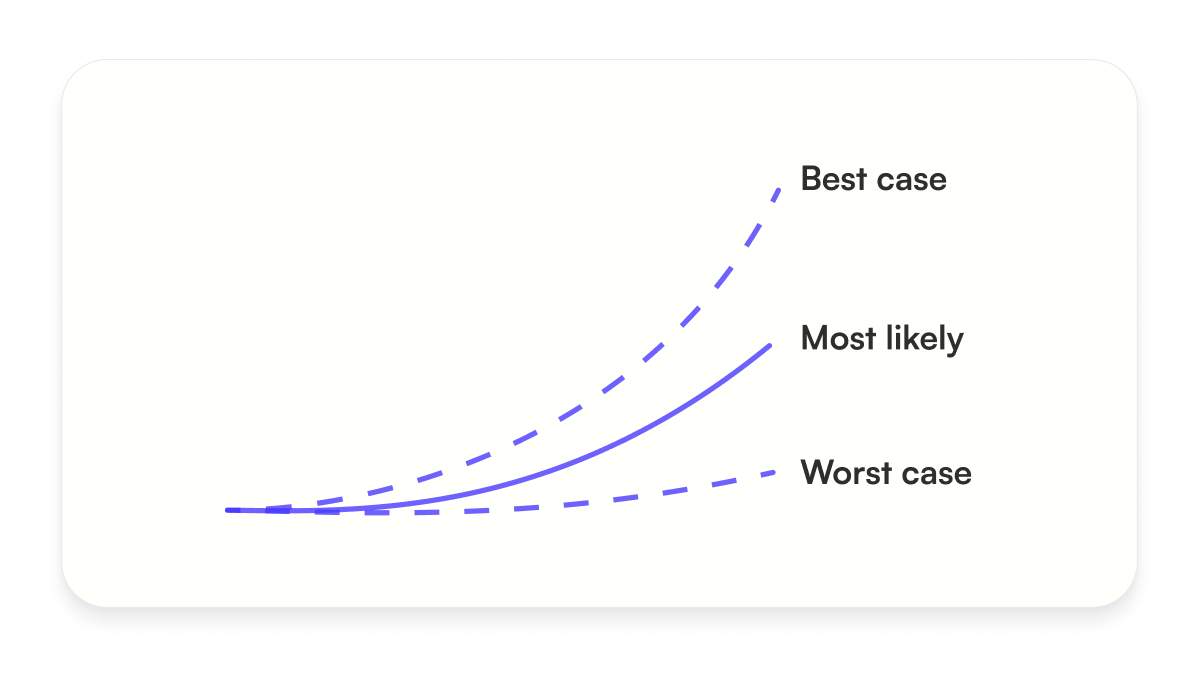
This binder represents somewhere between forty and four hundred hours of staff time, depending on how many consultants were involved. It was presented with great confidence. It was approved with great ceremony. It is now, with all due respect to everyone in that room, largely fictional.
Not because your team didn’t work hard. Because the future stopped cooperating.
The Quiet Failure of the Scenario Binder

Traditional scenario planning rests on a few reasonable assumptions: that the future will arrive in one of a limited number of identifiable shapes, that cause and effect will behave more or less as expected, and that there will be enough time between “uh oh” and “what do we do now” to actually consult the plan.
These assumptions are increasingly adorable.
Interest rates do not wait for your quarterly review cycle. Technology adoption accelerates in ways that make last year’s roadmap look like a historical document. Member expectations shift before you finish the survey designed to measure them. Regulatory guidance evolves mid-implementation, with the cheerful indifference of a weather system that didn’t read your forecast.
The result is that many credit union boards are doing enormous amounts of planning work to produce documents that are obsolete before the lamination dries. This is not a planning problem. It is a planning philosophy problem. And the fix isn’t to plan harder. It’s to plan differently.
The Question You’re Asking Wrong
Most boards in strategic planning mode are trying to answer one central question:
What will happen?
It is a reasonable question. It is also, at this particular moment in economic and technological history, almost impossible to answer with any useful precision. And yet boards keep asking it, commissioning elaborate answers to it, and then updating those answers every quarter when reality declines to match the projection.
Here’s the better question:
How do we intend to behave no matter what happens?
That is not a forecast. That is a posture. And it turns out posture is considerably more durable than prediction.
What Strategic Posture Actually Means (Without the Buzzwords)
Strategic posture is not a new framework, a software platform, or something that requires a two-day offsite and a facilitator with strong opinions about sticky notes (of which, I’m one!). It is a set of explicit, pre-agreed stances about how your credit union will behave in the face of uncertainty.
Posture answers the questions that scenarios keep deferring:
- Are we a fast follower or an early mover?
- Will we partner, build, or wait?
- How much margin compression are we willing to absorb in service of member experience?
- What will we protect even when the pressure to cut is loudest?
These questions don’t require predicting the future. They require self-knowledge. And self-knowledge, unlike a five-year forecast, does not expire.
A credit union with clear posture might say, for example:
We will prioritize member experience even when it pressures short-term margins.
That sentence is useful in a rate environment that goes up. It is useful in a rate environment that goes down. It is useful when a fintech competitor enters the market and when one quietly fails. Posture travels. Scenarios don’t.
Why Boards Are Uniquely Suited to Set Posture (and Rarely Do)
Here is a governance irony worth sitting with: boards are actually better positioned to define posture than to validate forecasts, and yet most boards spend most of their strategic time on forecasts.
Forecasts require operational depth that management has and boards generally don’t. A board that tries to critically evaluate a five-year projection model is largely dependent on the people who built it to explain why it’s credible. This is not oversight. This is nodding.
Posture, on the other hand, is exactly the kind of judgment boards are built for. Risk tolerance. Long-term values. Institutional identity. The question of what kind of credit union we want to be is not an operational question. It is a governance question. It belongs in the boardroom.
And when boards get posture right, something useful happens downstream: management stops needing permission for every decision that falls outside the scenario binder. When the CEO knows that the board’s posture is “invest ahead of demand in digital capabilities,” she does not need to schedule a special board meeting every time a digital investment opportunity appears. The posture is the guidance. The trust is built in.
When posture is vague, every decision becomes a board-level event. Which explains a lot about certain board agendas we could mention but professionally won’t.
How to Actually Do This
This is not about throwing out the strategic plan. It is about rebalancing where the board’s attention goes during strategy discussions. Specifically:
- Spend less time refining forecasts, more time clarifying intent. The forecast will be wrong. The intent will still be yours. Invest accordingly.
- Write the posture down. Unwritten posture is just a vibe. Vibes don’t survive leadership transitions, and they don’t guide management during a crisis at 11pm on a Tuesday. Explicit posture does.
- Test decisions against posture, not just scenarios. Before approving the next major initiative, ask: does this reflect who we said we are? That question is faster, more honest, and considerably less likely to produce a forty-slide deck in response.
- Revisit posture annually — not assumptions quarterly. Posture should be stable enough to anchor decisions and flexible enough to evolve when the institution genuinely changes. It is not a living document in the sense of “we update it every time someone gets nervous.”
Questions Worth Asking at Your Next Strategy Session
If your board is ready to try this, here are five questions that will either produce clarity or a very productive argument. Both outcomes are useful.
- How would we describe our current strategic posture — and is it actually explicit, or is it just implied and quietly disagreed upon?
- Where are we relying on forecasts that we know, privately, are unlikely to hold?
- What assumptions do we keep revisiting every quarter instead of making a decision about once?
- How confident is management in making decisions without seeking board approval — and is that level of confidence appropriate or alarming?
- If conditions changed abruptly tomorrow, would our posture guide us forward — or send us back to the binder?
Final Thoughts: The Binder Had a Good Run
Scenario planning is not worthless. It is, in the right doses, genuinely useful for stress-testing assumptions and preparing management for specific contingencies. Nobody is suggesting you throw the binder into the recycling bin with great ceremony, however satisfying that might feel.
But as the primary output of board-level strategic work, it has reached its limits. The world is producing disruptions faster than planning cycles can absorb them, and boards that spend their strategic energy predicting which disruption comes next are playing a game they will keep losing.
Organizations with clear posture move faster, argue less, and adapt better. They are not always right. But they are almost never paralyzed. And in a world where the future has stopped arriving on schedule, coherence may be the most underrated competitive advantage available.
The problem was never that you didn’t plan enough. It’s that you planned for a future that had other ideas. Time to plan for yourself instead.