Posts

Too Much of a Good Thing: The Hidden Perils of Capital Hoarding

 by That One Consultant You Hired and Then Ignored

If you’re a board member at a credit union, chances are you’ve said it. Maybe in a hushed boardroom voice, maybe with great conviction over lunch, maybe carved into stone tablets. It goes something like this:

“You can never have too much capital.”

Cue the heavenly choir and the flutter of regulatory examiners descending on clouds of GAAP. Capital, after all, is safety. Capital is security. Capital is your warm, fuzzy blanket on a cold night of economic uncertainty.

Except—and please, clutch your pearls tightly here—you can have too much of it. Yes, really. And when you do, it’s not just inefficient. It’s strategically dangerous.

Let’s talk about it, shall we?


Capital: From Safety Net to Strategic Straitjacket

First, let’s get the obvious out of the way. Capital is good. Regulatory capital is essential. You need it. The NCUA says so, and if the NCUA says jump, most credit unions are halfway to orbit before they ask how high.

But capital is a tool, not a trophy. When your capital ratio drifts into the teens—13%, 14%, 15% and beyond—you’re not just safe. You’re overdressed for the occasion.

Imagine showing up to a beach party in full medieval armor. That’s what it’s like running a 15% capital ratio in today’s credit union market. Impressive? Sure. But also a bit ridiculous, and not particularly helpful when it’s time to swim—or compete, innovate, or grow.


The Law of Diminishing Return on Paranoia

Many boards live by a simple mantra: More capital equals more safety. It’s neat. It’s easy. It’s… mathematically adorable.

But here’s the truth: every extra dollar of capital that sits unleveraged on your balance sheet is a member dollar not working, not producing value, not returning benefit.

Imagine telling your members, “We’ve taken your money, and we’re keeping it locked away in a vault, doing nothing, because someday the sky might fall. And if it doesn’t? Well, at least we felt warm and fuzzy.”

Not exactly the value proposition credit unions are known for.

And if your board’s idea of risk management is “hoard capital like it’s 2008 and Ben Bernanke just texted ‘brace yourself,’” then you’ve essentially traded strategic growth for a very expensive security blanket.


The Zombie Apocalypse That Never Comes

Let’s address the Doomsday scenario. Boards often justify massive capital buffers by invoking a theoretical calamity so devastating, it would make Mad Max look like a family picnic.

“We need to be ready for the worst-case scenario.”

Great. Let’s play that out.

Say a 500-basis-point rate shock, a recession, a Martian invasion, and a Nickelback reunion tour all hit at once. Terrifying? Yes. But unless your balance sheet is made entirely of subprime balloon loans and vibes, the odds of such a cataclysm wiping out your 10% capital buffer and then some are vanishingly low.

And even if it did, your regulator is unlikely to high-five you for sitting on a 15% buffer when 12% would have sufficed and the other 3% could have been used to actually serve members. You don’t get a trophy for hoarding potential.


“But the Regulators Like It!”

Sure. And your dentist likes it when you floss twice a day. Doesn’t mean it’s a viable identity.

Yes, regulators appreciate strong capital. But they also value operational effectiveness, loan growth, membership value, and risk-informed decision-making. They don’t want to see you building capital castles while the market passes you by.

Running a credit union solely to appease your examiner is like designing a car for your mechanic. Sure, they’ll love the engine access, but no one’s going to buy the thing.


Strategic Growth: Now Hiring Capital

Let’s talk opportunity cost.

Every dollar that sits in capital at a 14% ratio (when 10% would suffice) is a dollar not deployed into strategic initiatives. That’s a new loan program not launched, a branch not modernized, a digital upgrade not implemented, or a member segment not served.

You are, quite literally, overcapitalized and underutilized. That’s not caution—it’s stagnation dressed up as virtue.

And CEOs? If your board is holding you hostage with ultra-conservative capital policies, congratulations: you’ve been promoted to Chief Preservation Officer. Your job is to sit on a pile of money and politely decline to use it.

Spoiler alert: That’s not strategy. That’s surrender.


The PR Problem You Didn’t Know You Had

There’s also a branding problem with excessive capital. If word gets out (and it does—NCUA Call Reports are public, remember?), members, vendors, and yes, even regulators may start wondering:

Why is this credit union sitting on 15% capital when their peers are doing just fine with 10%?

Is it inefficiency? Fear? A pathological aversion to lending?

Whatever the case, the story isn’t flattering.


So, What Should a Board Do?

Ah, finally, solutions. You were getting anxious, weren’t you?

  1. Set a Capital Target, Not a Capital Shrine.

    Create a realistic, risk-informed capital target based on actual scenario modeling. Not vibes. Not trauma from the Great Recession.

  2. Regularly Reassess the Capital Buffer.

    If you’ve had 300+ basis points of excess capital for five years running, that’s not a buffer—that’s a moat. And you’re the dragon asleep in the middle.

  3. Tie Capital Deployment to Strategy.

    Capital should be the fuel for your mission, not a museum piece. Use it. Lend it. Invest it. Innovate with it.

  4. Educate the Board—Yes, Again.

    A board stuck in the “more is better” loop may need a refresher on how capital, risk, and growth actually interact. Spoiler alert: hoarding isn’t growth.


Closing Thoughts from Your Favorite Snarky Consultant

Let’s be clear: no one’s asking you to gamble with your capital. But don’t confuse risk management with strategic paralysis. The real danger isn’t the next economic downturn—it’s the slow erosion of relevance while your capital ratio quietly creeps toward 16% and your members quietly wonder why nothing ever changes.

So be brave. Be strategic. Be willing to sweat a little. And for the love of all that is cooperative and not-for-profit, stop worshipping at the altar of excessive capital.

Because in the end, the goal isn’t to die the richest credit union in the graveyard.

It’s to live boldly enough that your members actually notice.

The Fine Art of Going Along to Get Along: A Credit Union Board Tradition

By Kevin Smith

Credit union boards of directors have a well-documented, time-honored tradition of “going along to get along.” It’s an elegant, time-saving approach that ensures board meetings remain as peaceful and predictable as a slow-moving game of bingo at the senior center. No rocking the boat, no uncomfortable questions, and certainly no unpleasant confrontations. It’s a strategy built on the idea that if everyone agrees, then everything must be working just fine.

But, of course, that’s not always the case. This unspoken rule of unanimous harmony, while convenient, has a few tiny flaws—like, say, the potential to undermine the very purpose of the board itself. Let’s take a closer look at how we got here, why it’s a problem, and how to (gasp) fix it.

How We Ended Up in This Situation

The evolution of “go along to get along” governance is simple. It starts with a group of well-meaning individuals who join the board because they believe in the credit union movement. They’re here to make a difference! They’re here to help their members! And then they attend their first meeting.

What they find is an environment where disagreement is as welcome as a skunk at a garden party. They quickly learn that difficult questions result in awkward silence, darting glances, and, if things get particularly out of hand, a long-winded response that doesn’t answer the question but does ensure that no one will ever ask it again.

Soon enough, new board members realize that life is easier when they nod along, approve the agenda, and save their concerns for private grumbling sessions later. And just like that, another cog in the “go along to get along” machine is installed.

The Problem with Passive Boards

While group harmony sounds lovely in theory, it’s not exactly the hallmark of effective governance. Boards exist to provide oversight, challenge assumptions, and ensure the organization is actually serving its members—not just rubber-stamping the CEO’s latest PowerPoint presentation.

When boards avoid conflict at all costs, several unfortunate things happen:

  1. Lack of Accountability: If the board refuses to question leadership decisions, then no one is holding management accountable. Over time, this can lead to poor financial decisions, ineffective strategies, and policies that favor the credit union’s executives over its members.

  2. Missed Opportunities: Good ideas rarely come from an echo chamber. If everyone on the board is simply agreeing with each other (or staying silent to avoid disagreement), then creative solutions, innovative strategies, and potential improvements never see the light of day.

  3. Complacency Creeps In: A passive board creates an environment where stagnation flourishes. If no one challenges the status quo, then the status quo reigns supreme—whether it’s working or not.

  4. Risk Increases: The financial industry is full of risks, and credit unions are not immune. If the board isn’t actively engaged in evaluating potential threats, then they’re setting the credit union up for some unpleasant surprises.

Breaking the Cycle: How to Fix It

So, what’s the solution? How do we cure the boardroom malaise and encourage actual engagement without triggering a full-scale rebellion? Fortunately, there are a few ways to do just that and some of these should be familiar if you’ve been reading this blog for any length of time. 

1. Encourage Constructive Dissent

The first step to fixing a passive board is to make it clear that disagreement isn’t a personal attack—it’s a necessary part of good governance. One way to encourage this is to assign someone the role of “devil’s advocate” in discussions. (Many of you have heard me bring this one up before … repeatedly. It works!) If every proposal has at least one person assigned to poke holes in it, then dissent becomes part of the process rather than an act of defiance.

2. Change the Meeting Format

Most credit union board meetings follow a predictable (read: dull) structure. Reports are read, motions are made, votes are cast, and everyone goes home without a single bead of sweat forming. To shake things up, consider introducing strategic discussions as a standing agenda item and at the beginning of the meeting, rather than the end. Instead of only reviewing past performance, dedicate time to debating future opportunities and risks.

3. Board Education & Training

Many credit union board members come from backgrounds that have nothing to do with finance, risk management, or governance. That’s not necessarily a problem—diversity of thought is a good thing—but it does mean that ongoing education is essential. If board members don’t feel confident in their ability to challenge decisions, they won’t. Regular training sessions on financial oversight, regulatory requirements, and strategic planning can give board members the confidence they need to ask the right questions.

4. Rotate Committee Assignments

If the same board members serve on the same committees for years, they risk becoming too comfortable (or too cozy) with management. By regularly rotating committee assignments, credit unions can prevent stagnation and encourage fresh perspectives.

5. Recruit for Independence

Credit unions often struggle to find new board members, which leads them to recruit from within their existing circles. The result? A board that’s a little too familiar, a little too friendly, and a little too hesitant to challenge the status quo. Instead, credit unions should actively seek out independent thinkers—people with diverse backgrounds who aren’t afraid to ask uncomfortable questions. This should be part of your recruiting discussion from the get-go. 

6. Evaluate the Board’s Effectiveness

Finally, the board should regularly evaluate its own performance. Are members actively engaging in discussions? Are difficult issues being addressed? Or is everyone just nodding along, waiting for the meeting to end? Conducting anonymous self-assessments can help board members reflect on their own level of engagement and identify areas for improvement. You know very well that this is a hobby horse issue at TEAM Resources. 

A Little Discomfort is a Good Thing

Credit union boards don’t need to be battlefields, but they shouldn’t be tranquil meditation retreats either. The best boards strike a balance—encouraging open debate while maintaining mutual respect.

Yes, challenging leadership decisions can be uncomfortable. Yes, asking tough questions might make a few people squirm. But discomfort is not a sign that something is wrong—it’s a sign that something is being done right. Because at the end of the day, the credit union’s mission isn’t to make board members comfortable—it’s to serve its members. And that requires a board that’s willing to do more than just go along to get along.

Navigating VUCA: A Survival Guide for Credit Union Board Members

The whole world is facing the need to deal with increasing VUCA. Volatility. Uncertainty. Complexity. Ambiguity. Credit unions and their boards included. Directors must flex this muscle and practice dealing with all of these to bring their organizations into a future where they can continue to make a difference in their members’ lives.

By Kevin Smith, a full set of Encyclopedia Britannica and the full interwebs.

Being a credit union board member in today’s financial landscape is a bit like being the captain of a ship caught in a hurricane – except the hurricane never ends, the maps are outdated, and the crew occasionally votes to change course mid-storm. Welcome to the world of VUCA: Volatility, Uncertainty, Complexity, and Ambiguity.

If you were hoping for a stable, predictable environment where the hardest decision is approving the annual picnic budget, you may want to reconsider your life choices. But since you’re already here, let’s talk about how to steer your credit union through the financial chaos with grace, strategy, and perhaps a little gallows humor.

VOLATILITY: When Things Change Faster Than Your Meeting Agenda

Volatility in the financial services industry is as predictable as an overambitious budget proposal – inevitable and usually requiring last-minute adjustments. Interest rates swing, inflation rises and falls, fintech disruptors appear out of nowhere, and regulators seem to enjoy changing the rules just when you’ve finally understood the old ones.

How to deal with it:

1. Stay agile, not reactive. If you jump at every headline about the economy, you’ll exhaust yourself and confuse everyone around you. Instead, focus on long-term trends and build flexibility into your strategic plans.

2. Think in scenarios. When planning, don’t assume a single future. Have multiple game plans: “If rates go up, we do X. If they go down, we do Y. If the regulators invent a new acronym that changes everything, we call an emergency board meeting.”

3. Make peace with volatility. Just like how no one really knows what the stock market will do tomorrow, no one can promise you a smooth ride in the credit union world. Accept it. Adapt. And maybe invest in stress balls for your next meeting.

UNCERTAINTY: Otherwise Known as “Why Is This Happening?”

The financial world has a habit of delivering surprises. Maybe it’s a global event that upends the economy (again), or a new competitor that suddenly offers zero-fee everything. Maybe it’s just that nobody knows what younger generations actually want from a financial institution anymore.

Uncertainty is like being blindfolded and asked to hit a pinata except the pinata is moving, and you’re not sure it even exists.

How to deal with it:

1. Gather intelligence. No, you don’t need a spy network (although that would be fun). Just make sure your board is regularly reviewing industry reports, talking to experts, and keeping an eye on economic indicators. The more informed you are, the better your guesses will be.

2. Invest in adaptability. Uncertainty isn’t going away, so structure your credit union to handle surprises. Can you quickly shift resources if a new opportunity arises? Can your leadership team pivot if regulations change? If not, start building that muscle now.

3. Communicate with confidence (even if you’re guessing). Members and employees don’t want to hear, “We have no idea what’s happening.” Instead, try, “We are carefully evaluating multiple scenarios and will act in our members’ best interests.” It sounds better and prevents unnecessary panic.

COMPLEXITY: Where Everything is Connected, and Nothing is Simple

Remember when running a credit union just meant collecting deposits, making loans, and sending out newsletters with smiling stock photos? Those were the good old days.

Now, complexity rules. Regulatory requirements are labyrinthine, cybersecurity threats lurk in every corner, and technological advancements demand constant upgrades. And let’s not forget the delightful complexity of member expectations, which range from “I want personalized financial advice” to “Why can’t you just be an app on my phone?”

How to deal with it:

1. Don’t try to be an expert in everything. You’re a board member, not an omniscient being. Surround yourself with specialists – whether it’s compliance experts, cybersecurity professionals, or fintech advisors. Your job is to ask the right questions, not to have all the answers.

2. Simplify where you can. Complexity is inevitable, but unnecessary complexity is a choice. Look for ways to streamline governance, decision-making, and member services. If your processes resemble a Rube Goldberg machine, it might be time for a redesign.

3. Leverage technology wisely. Yes, AI, automation, and digital banking are important. No, you don’t need to invest in every shiny new tool that crosses your path. Be strategic – what actually benefits your members and makes operations more efficient? If the answer isn’t clear, it’s probably not worth the investment.

AMBIGUITY: The Art of Making Decisions with Half the Information

Ambiguity is what happens when the rules aren’t clear, the outcomes aren’t predictable, and no one agrees on what’s happening in the first place. It’s like trying to play chess when half the pieces are missing and the other half are actually checkers.

Maybe the government is discussing new regulations, but nobody knows what the final version will look like. Maybe your competitors are testing a new product, but it’s unclear if it’s a brilliant innovation or a financial disaster in the making.

How to deal with it:

1. Get comfortable with discomfort. If you need perfect clarity before making a decision, you’ll never make one. Ambiguity is part of leadership. Accept that some decisions will be made with incomplete data.

2. Lean on principles, not just policies. Policies tell you what to do when the situation is clear. Principles guide you when it’s not. If your board has a strong mission and clear values, those can be your North Star when ambiguity clouds everything else.

3. Be willing to course-correct. No decision is final. If new information comes in that changes the situation, don’t cling to a bad choice just to save face. Adapt, adjust, and move forward.

Final Thoughts: Thriving in VUCA

If you’ve made it this far without resigning from your board seat in frustration, congratulations. The truth is, VUCA isn’t going anywhere. Volatility, uncertainty, complexity, and ambiguity are just the price of doing business in modern financial services.

But here’s the good news: credit unions are uniquely positioned to handle this chaos. Unlike big banks driven by shareholder profits, credit unions are built on community, trust, and adaptability. If you can embrace change, make informed decisions, and stay focused on your members, you’ll not only survive in a VUCA world – you might even thrive.

And if all else fails, there’s always coffee. Lots and lots of coffee. If you’ve met me, you know that this is my go-to strategy. :-) 

Should Paid Directors Be Held to a Higher Standard?

More credit union boards are moving to or considering payment for service. This means that boards need to reconsider their standards of engagement and director performance. It will be important for boards making this change to re-calibrate expectations.

By Kevin Smith

Ten to fifteen years ago there were two topics sure to get credit union board members riled up and talkative at credit union conferences and training: term limits and paid directors. But I have to say that these discussions instigate far fewer sparks and consternation than they used to. When I was facilitating board roundtable discussions, I used to love to throw those two hand grenade topics and run to watch the smoke fly. It’s generally not a bad thing when people are passionate about things and care about them enough to get animated in their discussion.

Recently, I’ve been involved with a few discussions about the payment of directors. While the overall idea of it has become less polarizing, what I’m noticing is that, as usual, the devil is in the details, and there are quite a few nuances to the application of this idea that can still heat up the room. Primarily, the issue is whether paid directors should be held to a higher standard.

Some of the circumstances to consider:

How large is the payment? For some it’s a nominal stipend. A couple thousand dollars a year. For others it’s low to mid five figures. For some this difference matters a great deal when talking about raised expectations for the role.

Does paying directors have regulatory implications? Does this affect how lawmakers perceive who credit unions are in the market? Lobbyist for our industry are careful to dance around this one, as one of their primary talking points when hiking the hill is the not-for-profit model run by volunteer directors.

One director told me flat out – “we’ve been doing a lot of work for a lot of years already. We’re just now getting paid for that work. So, no, the expectations should go up. I’m already earning that money.”

Naturally there are those who take the opposite stance. The addition of remuneration to a formerly volunteer position changes the tone of the position dramatically.

What’s the Goal

There are also nuances to how boards come to the decision to pay their director members. (And sometimes there are differences within the same board as to these reasons!) Payment can simply be an acknowledgement of the work. But regularly this discussion is about efforts to recruit candidates (and higher quality ones) for a job that has become far more complex and time consuming. We hear a lot of worries in the industry about how difficult it can be to get new, and younger directors to join the movement as part of the board. Payment is the carrot/incentive to make this worthwhile to candidates.

My View

Over the years, I’ve softened to the idea of paying directors. I know just how much work there is and how important it is to have the right people in those seats. With the right understanding of the membership and evolved strategic thinking skills. A salary or stipend just might help in recruiting. But then I worry that people are attracted to the role for the dollars rather than the mission. At the basic level, the mission and purpose should be what attracts the potential board member. This is what we’ve done for a century now – get people to drink the credit union Kool-Aid and see what people-helping-people can do for the world.

So, they paycheck doesn’t change the job, but it does change the perception of it. Because there is such a long history of volunteer board members in this movement, I do believe that the just the perceptual change of adding pay is significant, to the members, the regulators, the general public, etc. And that change suggests to me that there also needs to be change in the performance of the board. I think that is a reasonable expectation as a sharp contrast to the history of the voluntary position. We hope that increased costs to the credit union come with increased value.

Be Careful What You Wish For

There are other sticky wickets to watch out for in this territory. Plenty of credit union boards count on (i.e. hope) that tenured directors will self-select out of their roles when they are no longer “high performing.” (This tees up that other incendiary topic of term limits.) Of course, this doesn’t happen nearly enough. As Tim Harrington says, “If you think some of your directors are sticking around too long, start paying them and see what happens!” 

Our Vantage Point

Tim and I encourage already boards to raise their standards and performance expectations all the time, whether there’s pay or not. So maybe we’re not the two people to weigh in on whether to do it. But we do believe that it changes perceptions. There is a lot to talk through and consider on the issue. Don’t take it lightly. It can be awfully easy to agree to a new paycheck for work you’re already doing. Do it of the right reasons.

Making Your Board Meeting Agenda More Strategic

Boards can keep their focus on strategy sometimes by tweaking small things like the board meeting agenda. Prioritizing strategic discussion early in the board meeting forces this focus, downplays the operational to the benefit of all involved.

By Kevin Smith

Prompt: An unorthodox board meeting room. From Leonardo.AI

I’ve seen a lot of credit union board meeting agendas. They’re not identical, but they do tend to be pretty similar. It’s pretty common for the consent agenda to be the first item. This can feel like a big  of something accomplished right away – with a whole lot of bullet points underneath! It feels like momentum gathering, right? Now, don’t get me wrong. I’m not knocking the consent agenda. You absolutely should be using it. And if you aren’t go here and explore what it is. It’s fabulous. But I’m going to throw a bit of a wrinkle here and suggest that it shouldn’t be the first item on your board agenda.

Listen to Tim

This concept comes from my partner, the inimitable Tim Harrington. He and I have been spreading this idea whenever possible, and that is to make sure that strategic discussion is the first item on your board agenda. Prioritize it!

Prioritize

Prompt: An unorthodox board of directors meeting room designed by Pablo Picasso. From Leonardo.AI

What often happens is that we like to get a bunch “must do” items checked off of our agenda and out of the way so that we can get to the “big” stuff. Then, inevitably, these perfunctory, “must do” items bring up questions that need answers, and side tracks, and rabbit holes. The next thing you know, you’re at the end of the scheduled time and there’s nothing left for the juicy strategic discussions. Either you’re out of time or out of gas for the most important stuff. And let’s be honest – many of those “must do” check marks lead you into operational weeds, don’t they? (I know within reason that they do because I work with a lot of boards and I hear about it constantly.)

Tim told me about one of his clients that made this simple change to the agenda and the fabulous results that they got. They told him of their inevitable decline into operations with the first couple of items in their agenda and the constant short shrift that strategy got, OR, how very lonnnnggg their meetings became. By putting strategy first, they got to the good discussion, but then were able to “fit in” the rest of the items without devolving into the weeds. It’s efficient in so many ways. They were amazed at how different the tone of the meetings was, and how much better.

No Copy And Paste

Prompt: An unorthodox board of directors meeting room designed by Henri Matisse. From Leonardo.AI

Many of you may be using ctr+C and ctr+V for your agendas and have for a very long time. I challenge you to shake things up a bit. Try something new. Spend more time on the most important element of your job as a director. It’s amazing how some minor adjustments to the nuts and bolts of the job can have such a profound impact on the work you do. It’s important to look carefully and regularly ask, “why do we do it this way?”

Now … don’t get me started on the shape of the table in the board room and who sits where …. A discussion for another time.

About the Images

Naturally, I’m jumping on the AI bandwagon like everyone else. (I’m here to learn.) And since my blog topic was about shaking things up a bit I wanted to see what Leonardo.AI would spit out for me. 

The first image prompt was “an unorthodox board meeting room.” And what you see is pretty M’eh, in my opinion. Yes, it’s got a few out of the ordinary items in there, like the stuffed owl. But otherwise it looks pretty recognizable. The table shape is as predictable as it gets!

The second image prompt was “an unorthodox board meeting room designed by Pablo Picasso.” Now we have some great things to look at but otherwise, it’s still a predictable board room. It looks like the board room for the Picasso Foundation. Booorrrring!!

The third image prompt was “an unorthodox board meeting room designed by Henri Matisse. Now we’re getting somewhere! It’s my favorite, but then again Matisse is my favorite as well. At least the word “unorthodox” carries some weight here. 

Honestly, all three were disappointing. We’re learning that AI has some interesting things to show us, but there are certainly limitations. Maybe I need to work on my prompts? Human creativity is far superior. (But what will these look like in a few years?) 

10 1/2 Team Building Options for the Board

Like any other team, the credit union board of directors must make intentional efforts to develop and work well together. Too many boards ignore this outright or give it lip service. We can be creative in approaches to work better as a group and as individuals.

By Kevin Smith

It’s a given that organizations, corporate or nonprofit or other, should take steps towards developing its teams from groups of disparate individuals to partners who trust each other, support each other and work interdependently. However (comma) I rarely see it happening among boards. That should change. If you’ve seen me speak or read many of the TEAM Resources blog posts, this will be familiar turf. My stock line is, “we (as boards) get together for 1 ½ to 2 hours a month, and expect to perform like the Navy Seals. It ain’t gonna happen.” So, this month we’re going to talk about practical options and examples that you will enjoy. And this list is going to fall short. Some of you are going to have great ideas that I’m missing. We need to hear them! Share please. We’re credit union people. It’s what we do.

Of course, I can’t help but share with you here my favorite team building picture as a cautionary tale of what NOT to do. Please. No public shaming as team building. :-)

What Counts as Team Building

When I harp on this topic, sometimes boards tell me how they have dinner together after board meetings, go to golf outings together, or go to conferences as a group and spend time together in the evenings. These things certainly have value in helping individuals to get to know each other better, and that’s not a bad thing. But it falls short of development. Team building is best when it’s the full group and there is intentional activity meant to help people to function better together.

Now we’ve all seen funny (or horrifying) stories about team building gone wrong, with trust falls, ropes courses, etc. I’ve been through a few cringe-worthy sessions myself. Not all of the options fit all of the people. It’s probably apparent that scavenger hunts and building towers out of straw, tape and string are not my things. But some people love them. My preference is for activities that tie into our work as a board and our individual styles to make them gel.

An Incomplete List of Options

Personality/Working Style Assessments

The Workplace Big Five is my favorite of these. (I’m certified to present this. That’s your only sales pitch.) Disc is a favorite of many that I know. I have a total bias against Myers-Briggs based on the (lack of) science behind it.

[A board I was working with had a total breakthrough with the Big Five as we talked about their group having one “challenger,” with the rest going with the flow. They were pretty happy that they had her as the pushback, but she spoke up about the weight that she felt being the only one to do it. They found a way to let her off the hook at times. Changed the whole board dynamic!]

Field Trips

I did know ONE board who did great, intentional team development. They took field trips to civil war battlefields. They spent some time with tours and lessons and then did a leadership debrief. Fabulous!

Volunteer Work

This option is certainly valuable to the community and feels good. But to make sure that it fits the bill of team development, make sure that it has a leadership debrief element.

Hunt for Local “Outstanding” Organizations

This is great when it’s withing your community. Take the time to understand the organization, and examine what makes it great. Discuss how the leadership got them there and what you can take back to the credit union. (This is similar to Simon Sinek’s version of a worthy rival.) The debrief is essential.

Corporate Tours

Breweries and distilleries are always a hit. Also consider candy makers, or bakeries, or companies that do something very interesting. Look for their purpose, core values (or lack thereof) and discuss how those play out in their work.

Review of Regional Award Winners

When local companies or groups show up on a “best” list, pick some to analyze and share the lessons. (The fun flip side to this is to do a post-mortem of a corporate failure.)

Tours in D.C.

Of course, the board should be going to GAC in D.C. I know it’s a busy week, but consider taking a tour together as a board and unravelling what you learn. (I highly recommend the spy museum)

Yes. I can count. No. There aren’t 10 ½. I am counting on you fine readers to add to this so we have more than 10. (See what I did there? *counting*)

Do something creative.

          Do something interesting.

                    Do something intentional.

                              Do something.

The Strategic Premortem

Board members collaborating with the senior leadership of a credit union can benefit from a strategic premortem. By analyzing the strategic goals under the assumptions that they have failed or “died” leaders can generate risks to be aware of. This approach requires a unique critical lens and set of skills that directors should flex and develop.

By Kevin Smith          

Here we go again with the Latin phrases. Kevin is at it again as if he’s back at his Jesuit high school. The postmortem is a common enough phrase: the after-death analysis of what went wrong. Beyond the realm of autopsies, the postmortem is a familiar approach to finding out what went wrong with projects that failed to reach their objectives. But where does the premortem fit in?

As you may have intuited, the premortem comes at the beginning of a project or strategic planning cycle. Those involved review the plan with an eye to the future where the plan has failed to reach its goals. This is an opportunity to consider what might go wrong and plausible reasons for failure.

The Value

This is a valuable exercise for board members who should always be looking for ways to improve their strategy muscles. Harvard Business Review cites research that “found that prospective hindsight—imagining that an event has already occurred—increases the ability to correctly identify reasons for future outcomes by 30%.” The approach requires a different kind of focus than the board typically engages in. It goes beyond a standard risk analysis.

Don’t Go It Alone

We recommend that the board engage in the premortem analysis along with the senior leadership of the credit union rather than on its own. This may require a level of operational insight that the board may not have (and a level that we don’t necessarily encourage). But it is helpful for the board to participate in this kind of analysis.

One Approach

One approach to the strategic postmortem is to review the plan, inform the group that the plan has failed, then ask all of the participants to independently write down as many reasons as they can think of for the project’s demise. Group members share their responses and look for themes, outliers, and probabilities. Anonymity can be a value in the process depending on how much psychological safety there is in the room. This may allow not only for candor, but also for unique insights that aren’t part of a risk profile.

Resources

There are a number of ways to perform the strategic premortem. A Google search will yield plenty. A template such as this one from Creately may help you organize the process and not recreate the wheel.

Be Careful But Flex

When taking on this exercise, it is important for directors to be careful in their analysis and not “punt” with oversimplifications like “the regulators put us out of business” or “we were forced to merge.” It’s critical for credit union directors to ramp up their capabilities regarding strategy to address the complexity of our industry and rapid evolution. The strategic premortem is but one of many lenses that help improve understanding and ability. Try as many as possible.  

“Kill the Company”

Another similar option is Lisa Bodell’s Kill the Company. In her book, Bodell outlines approaches for analyzing your organization from the point of view of an outsider in the same industry with the intent of putting you out of business. This requires participants to not only understand the strategy of the organization, but also to be frank and open about what weaknesses are open to exploitation. It can be difficult to think this way, but tremendously valuable. Be aware of egos in the room that would balk at this kind of candor. Reinforce that this is for the good of the organization.

Sometimes we need to mix it up, make sure we’re not stuck in a rut with our strategic thinking. This is part of the job of the board. Give it a shot!

Radical Candor in the Boardroom

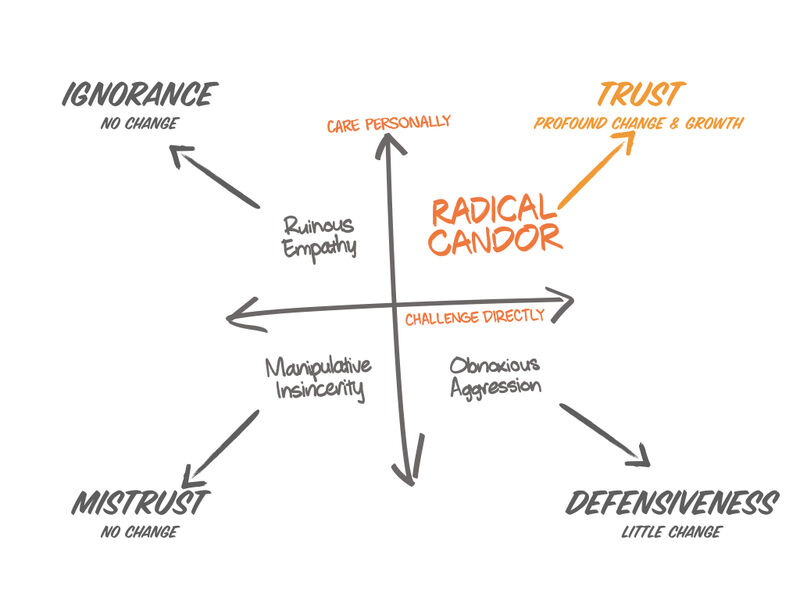
To promote high performing teams, approaches like radical candor can be of great value. The concept of challenging directly but caring personally creates a better environment. Boards of directors should make concerted efforts to establish honest and trusting environments. Used thoughtfully radical candor can inspire change and growth.

By Kevin Smith

Recently, I ran across the concept of “Radical Candor” from Kim Scott, while preparing a session I was presenting at a conference. The terms itself, Radical Candor, feels much edgier and biting than what I had been looking at and it drew my curiosity. Naturally, everything I dig into quickly gets reframed as to how it relates to credit union boards of directors. This was no different. But here it wasn’t a perfect fit, though there is serious merit in how this concept could (should) get traction with boards.

The Source

Author Kim Scott has quite a professional pedigree, having been part of AdSense, YouTube and DoubleClick teams at Google, as well as a CEO coach at Dropbox, Qualtrics, and Twitter among others. She’s been a manager, a boss and a leader in a lot of different scenarios. She’s very candid about how she learned, the mistakes she made and how she developed the concept of radical candor and wrote the book.

The Concept

The concept is fairly simple and it uses a 2×2 which is the rule for card carrying consultants. :-) The x axis is the degree to which you challenge your employees directly. The y axis shows the degree to which you care personally. (See graphic and cover.) That’s really it. As she puts it, “You don’t have to choose between being a pushover and a jerk…you can be kind and clear at the same time.” The key to this approach is to be direct with people, but to “give a damn” about them and make it clear that you support them. It’s really simple. Of course, the implementation of this opens a variety of cans of worms, because, after all, we are human beings that are complex, nuanced … and emotional.

The Goals

The book is absolutely geared to making people better “bosses.” So how does this relate to boards of directors who operate distinctly outside of a corporate hierarchy by being peers in the boardroom? Scott indicates that the three core responsibilities of bosses are to:

  1. Create a culture of compassionate candor
  2. Build a cohesive team
  3. Achieve results collaboratively

These are goals for the board as well.

The Need

My experience with boards of directors around the United States suggests that we could use a lot more radical candor (compassionate candor) in the boardroom. This is hard enough for bosses to achieve with their direct reports and the board setting has further challenges. As groups of directors, it’s critical that we address issues, failures and lack of performance from colleagues on the board. This doesn’t happen nearly enough and many boards “tolerate” certain director who don’t live up to the needs of the organization. Of course, this candor has to be accompanied by deep personal care for each other and the support that this requires.

Now, I’m giving very short shrift to Scott’s concept here, providing only a thumbnail sketch of everything involved. I encourage you to read the book, explore some articles or videos on the concept and see what you think. She provides a very detailed approach and order of operations for executing this along with great examples of the process.

How to Adapt

Unfortunately, this isn’t a hand and glove fit for boards, as we don’t have bosses. And I haven’t worked through all of the nuance that Scott does. But I want you to consider how this might be a value for a peer group like your board. There’s significant value here. Don’t you think?

Here’s a suggestion from Scott as to how to start building this culture:

  1. Be the first to solicit criticism from your peers.
  2. Gauge the conversations as you give criticism: If your listener is upset, ratchet up the care personally side of things. If they are not hearing you, challenge more directly.
  3. Encourage all candor and discussions.

We owe it to each other and to the credit unions to which we pledge an oath of office to work at the highest level possible.

I want to hear your thoughts.


Board Packet Purge

Good governance and strategic vision are influenced by the materials that the board sees and hears. It’s important to periodically take stock of those materials to make sure they are not only  aligned with strategic goals, but that they also useful. Boards are often resistant to the board packet purge, opting to add materials, but never reduce.

By Kevin Smith

How many pages is your board packet? Seriously. Go check. How much does that vary month to month? And how many times have you gotten that packet before a board meeting and let out a bit of a *sigh* as you get ready to review it? Be honest. I remember doing it when I was on a supervisory committee. It can be a daunting task. At least we no longer live in the age of paper board packets that take three days for your staff to photocopy and then send out via FedEx. (Please tell me you don’t have paper packets still! If you do, email me privately. We’re going to chat.)

There are very few credit union jokes, but the one that I know is this: “What is the most terrifying sound to a credit union CEO? Answer: The sound of a board packet being opened at the beginning of a board meeting.” :-) 

In some ways the digital board packet can make things worse, because it is so much easier to add reports, data, detritus and links to spreadsheets in the digital realm. This just adds to the volume. Consider how much time the board spends as individuals reviewing dozens (and dozens) of pages each month. You want this to be valuable time.

Take Stock

It’s time to go through the packet and take stock of what’s in there, determine if/how it connects to the strategic plan, and figure out how to winnow things down to what’s necessary and useful. I’m not suggesting that the goal of this exercise is to get the packet as small as possible. The goal is to make it as useful as possible.

What we often hear when advising boards about this process is that they discover a couple or ten reports that are in the packet every month, and always have been, that no one currently on the board knows why they’re there. Often it was something that a former board member asked for years ago that got added, and there it remains. New board members join and absorb the culture of the board and its packet, and presume this is something that they need to know and understand. They simple accept it as part of the status quo. It might be something that was tied to a strategy approach that is long gone. But there it remains. If the board can purge even a couple of items like this, it is moving towards greater efficiency.

Ties to Strategy

The goal of the packet is to inform the board about how the credit union is moving towards its strategic goals and to provide relevant context. Make sure every item has a direct connection at the appropriate level of detail. This level of detail should also evolve, depending on where you are in the process. For example, a brand-new branching strategy will require more detail at the beginning and you will trim it after some time and progress. Avoid having items that are locked in place once they are added. The packet should evolve, expand and contract regularly. It is not static.

Reigning in the Directors

One approach to the packet is to make sure that any potential new additions come to the full board for consideration and a vote before adding them. Also, get the CEO’s very honest thoughts on any additions. This should be a written policy. The board then must force itself to think about how the new information will serve to inform the strategic governance of the board and avoid individuals who just want to see things.

No Perfect List

Of course, I know that what you’re looking for from TEAM Resources right now is the perfect list of items to put in the packet. And of course, you know, if you’ve heard me before, my answer is “it depends.” There is no perfect list. You need to customize this to your credit union, to your strategic plan and to the culture of your board. That doesn’t mean that you shouldn’t take on this project in the effort towards efficiency.

Dashboards

The visual representation of data is your absolute friend here. It’s so much easier and more efficient to have your information in dashboards that show you trends and targets. My snarky response is that I want to be able to take off my trifocals and be able to tell whether the trends are on target or heading astray. If they’re on target, I don’t ask any more questions.

The Arguments

There are a couple of common arguments about slimming down the board packet. One is that the board has a fiduciary duty to oversee what’s happening in the organization and that involves examining the individual numbers. I agree about the fiduciary duty. But once you learn where the numbers are coming from and that you can trust them, then the dashboard is sufficient and efficient. This also helps keep directors from getting too far into the weeds. (I’d also suggest that the auditors are far better at this kind of work than your average director.)

Another argument is that the board should have access to any and all data in an effort towards transparency, so that the CEO or staff aren’t “hiding” something. This is reasonable and it’s easy to link to the deeper data for an occasional review outside of the norm. This is also often where new directors learn the ropes of the financial. Learn it well enough and quickly enough to know what you can ignore. And consider that it is also possible to “hide” things by burying the board in date.

Not a “One and Done”

Over the years, Tim and I have encouraged this process and have seen some success. Remember, this is about efficiency. Make sure your meeting preparations are worthwhile and not mind-numbing reviews of hundreds of pages. So, if you’ve done the packet purge and found efficiencies, don’t presume that you’re done for a generation. Repeat the process every couple of years. The more often you do it the quicker it will be as well.

Strategic Efficiency is the goal. We cannot afford to waste time.

Addressing Underperforming Directors

Ignoring the behaviors and activities of an underperforming director can have dramatic consequences. Yet among a group of peers such as a board of directors too often these scenarios go unaddressed. It may be easier in the short run to avoid dealing with the problem but it rarely gets easier. This is, in fact, a duty of the board.

By Kevin Smith

“Sadly, boards are more likely to replace a CEO than oust one of its troublesome board members.” Beverly Behan, Board Consultant

Someone is going to call me out on the fact that I’ve used this quote before. I hope they do. It means someone is paying attention. (See the original post here.) But this one needs further attention because I don’t believe circumstances have changed much, if at all. It’s a doozy of quote too. (Tim and I used it in our book too. It makes a dramatic point!).  

 The first time I used the quote in a blog post was in 2016. In my mind that’s long enough to warrant revisiting. But in that post we were writing about renomination and what directors need to demonstrate to earn renomination to the board ballot.

Today, I’m writing about addressing underperformance and having uncomfortable conversations. This is about confronting issues, rather than ignoring them or simply having hushed discussions in hallways after meetings, where nothing gets resolved.

Common Problematic Behaviors

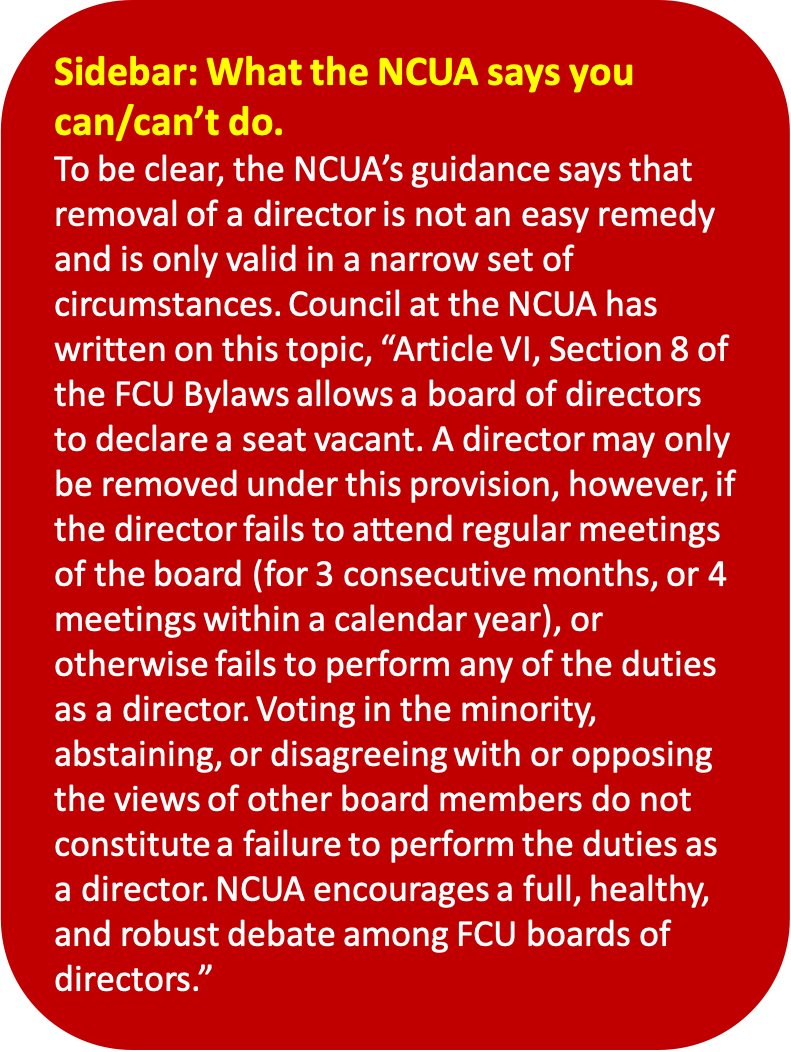
Click the sidebar to see the full letter.

Here are some of the negative/troubling things that I hear about around the country in my hundreds of conversations with directors, CEOs, senior leaders, as well as with others related to board work.

Directors who:

  • Fall asleep during board meetings
  • Are clearly never prepared
  • Are way, way off topic on a regular basis
  • Have experienced mental decline, age related or otherwise
  • Talk far too much (or far too little)
  • Bully staff and colleagues on the board
  • Don’t do what they agree to do (think of those who have to be chased down for everything and never hit a deadline)
  • Cannot let personal feelings and opinions go when the vote goes against them

I’m sure you can add your own examples. (And please do in the comments below. It helps others to know they’re not alone.) These are the most common ones I hear about. And you can let your imaginations run wild with the damage that these behaviors can cause to the board and the credit union. You may have some actual terrifying anecdotes. Don’t underestimate what’s at stake.

In previous blogs, you’ve read about the TEAM Resources approach to strategic governance via written policy to provide tools for managing these scenarios. But let’s talk about actually getting beyond the discomfort of the circumstances and dealing with humans in a way that doesn’t have to be confrontational or hurtful.

Addressing Behavior

  • First, remember your humanity and empathy. You have to confront the situation but it doesn’t have to be confrontational, negative and accusatory. Consider where this director may be coming from, and what they may be dealing with in their life. Keep the discussion as positive as possible.
  • Always start from an assumption of best intentions. Don’t presume malicious intent unless you have significant evidence of that.
  • Schedule a time to meet with the individual one-on-one. This is never something to address in front of a group.
  • Be specific about the behavior you are witnessing and how it may be coming across. “I noticed at the last board meeting that you didn’t seem engaged with the meeting. Your attention seemed to be somewhere else and you didn’t contribute as much as you have in the past.”
  • Ask about the circumstances and be ready to listen and really hear what is going on. Use active listening techniques.
  • Offer support. “How can I, and we as a board, help you so that you can fully perform your duties? What do you need?” You’ll be surprised how far this will get you, either in the desire for help or in the acknowledgement that the behavior is happening and needs to be addressed.
  • Be clear about what plan is in place and a timeline for making things better. “In the next two board meetings, can you try to make sure that you are not the first person to speak up so that we can make room for other voices? And we can see how that goes.”
  • Refer to your well-written governance policies that address how the board has agreed to work as a group. Remind them that this is what they signed and agreed to and that the current behavior violates the policy. “Part of our governance policy on behavior states, ‘Board members will be properly prepared for Board deliberation. This includes, but is not limited to, reading board packet materials in a timely manner, keeping up with industry trends and issues, ongoing training and education that is specific to the individual needs of each Board member.’ And you are not holding up your end of that requirement.” This approach keeps things formal and professional, and keeps your involvement at a professional and not a personal level.

Often, after taking these steps problem directors will see own up and offer to step down. Handled with compassion this doesn’t need to be a fight or a negative circumstance. Though, I can’t promise that this will always be the case. Humans can be messy. But I do know that this approach is far more effective than accusations and confrontations.

Whose Responsibility Is This?

The easy answer as to who should do this is the board chair. That really is part of the job description for someone who is primus inter pares, first among equals. So, if you’re not up to this kind of discussion you can lean in and realize that it is a skill that can be learned. Or, you may have to step back and recognize that by not taking on this task is dropping the ball for the job in a way that can damage not just the board, but the entire organization. If that’s the case, you might not be the right chair for the job. (Small consolation for some of you who “ended up” as chair, I know.)

But I also want to put it out there that it doesn’t have to be the chair’s job. Anyone on the board can take up this task. Remember, you are equals. And with the right kind of culture and trust, it’s reasonable that we should expect all directors to bear the weight of accountability for the group.  

Courage

What I’ve described requires some intestinal fortitude and won’t always work perfectly. It also provides some guidelines that make this less difficult with opportunities for very positive outcomes. If expectations are clear and agreed upon by the board as a whole, you have a foundation for addressing underperformance. But ignoring the situation can never be an option. There’s too much riding on the board.


As always, please tell me what you’ve tried and what I’m missing. I never claim to be perfect or completely comprehensive.

© Copyright 2022 - Site design by Sprout Studio in Madison, WI