
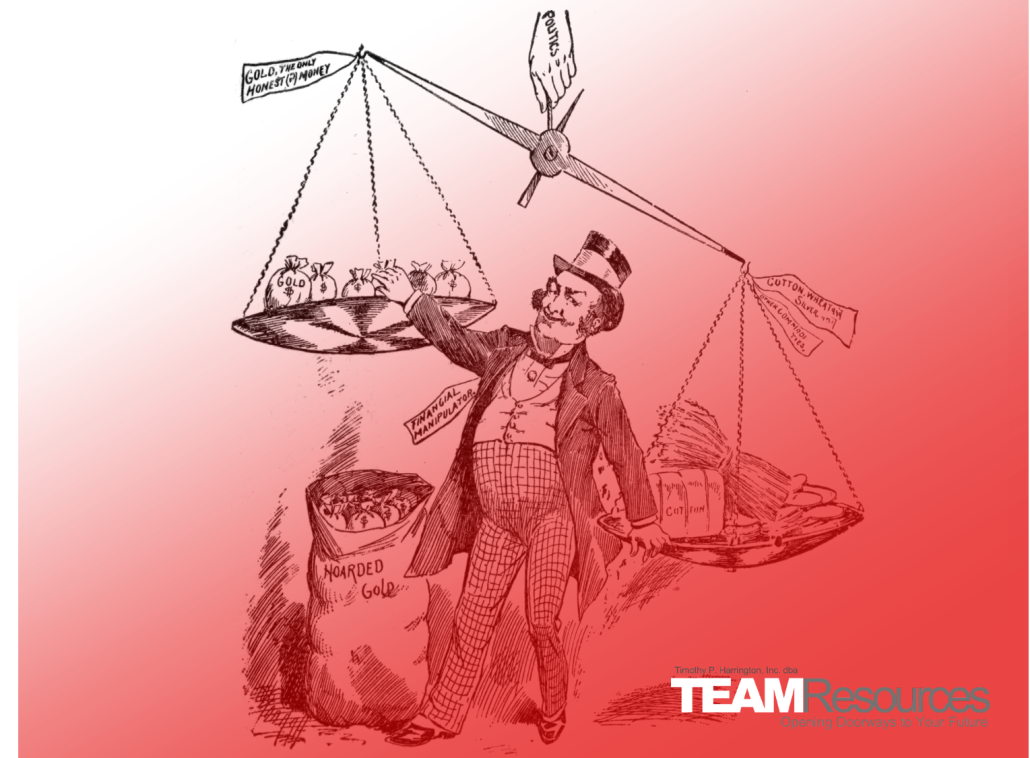
Too Much of a Good Thing: The Hidden Perils of Capital Hoarding
 by That One Consultant You Hired and Then Ignored
If you’re a board member at a credit union, chances are you’ve said it. Maybe in a hushed boardroom voice, maybe with great conviction over lunch, maybe carved into stone tablets. It goes something like this:
“You can never have too much capital.”
Cue the heavenly choir and the flutter of regulatory examiners descending on clouds of GAAP. Capital, after all, is safety. Capital is security. Capital is your warm, fuzzy blanket on a cold night of economic uncertainty.
Except—and please, clutch your pearls tightly here—you can have too much of it. Yes, really. And when you do, it’s not just inefficient. It’s strategically dangerous.
Let’s talk about it, shall we?
Capital: From Safety Net to Strategic Straitjacket

First, let’s get the obvious out of the way. Capital is good. Regulatory capital is essential. You need it. The NCUA says so, and if the NCUA says jump, most credit unions are halfway to orbit before they ask how high.
But capital is a tool, not a trophy. When your capital ratio drifts into the teens—13%, 14%, 15% and beyond—you’re not just safe. You’re overdressed for the occasion.
Imagine showing up to a beach party in full medieval armor. That’s what it’s like running a 15% capital ratio in today’s credit union market. Impressive? Sure. But also a bit ridiculous, and not particularly helpful when it’s time to swim—or compete, innovate, or grow.
The Law of Diminishing Return on Paranoia
Many boards live by a simple mantra: More capital equals more safety. It’s neat. It’s easy. It’s… mathematically adorable.
But here’s the truth: every extra dollar of capital that sits unleveraged on your balance sheet is a member dollar not working, not producing value, not returning benefit.
Imagine telling your members, “We’ve taken your money, and we’re keeping it locked away in a vault, doing nothing, because someday the sky might fall. And if it doesn’t? Well, at least we felt warm and fuzzy.”
Not exactly the value proposition credit unions are known for.
And if your board’s idea of risk management is “hoard capital like it’s 2008 and Ben Bernanke just texted ‘brace yourself,’” then you’ve essentially traded strategic growth for a very expensive security blanket.
The Zombie Apocalypse That Never Comes

Let’s address the Doomsday scenario. Boards often justify massive capital buffers by invoking a theoretical calamity so devastating, it would make Mad Max look like a family picnic.
“We need to be ready for the worst-case scenario.”
Great. Let’s play that out.
Say a 500-basis-point rate shock, a recession, a Martian invasion, and a Nickelback reunion tour all hit at once. Terrifying? Yes. But unless your balance sheet is made entirely of subprime balloon loans and vibes, the odds of such a cataclysm wiping out your 10% capital buffer and then some are vanishingly low.
And even if it did, your regulator is unlikely to high-five you for sitting on a 15% buffer when 12% would have sufficed and the other 3% could have been used to actually serve members. You don’t get a trophy for hoarding potential.
“But the Regulators Like It!”
Sure. And your dentist likes it when you floss twice a day. Doesn’t mean it’s a viable identity.
Yes, regulators appreciate strong capital. But they also value operational effectiveness, loan growth, membership value, and risk-informed decision-making. They don’t want to see you building capital castles while the market passes you by.
Running a credit union solely to appease your examiner is like designing a car for your mechanic. Sure, they’ll love the engine access, but no one’s going to buy the thing.
Strategic Growth: Now Hiring Capital
Let’s talk opportunity cost.
Every dollar that sits in capital at a 14% ratio (when 10% would suffice) is a dollar not deployed into strategic initiatives. That’s a new loan program not launched, a branch not modernized, a digital upgrade not implemented, or a member segment not served.
You are, quite literally, overcapitalized and underutilized. That’s not caution—it’s stagnation dressed up as virtue.
And CEOs? If your board is holding you hostage with ultra-conservative capital policies, congratulations: you’ve been promoted to Chief Preservation Officer. Your job is to sit on a pile of money and politely decline to use it.
Spoiler alert: That’s not strategy. That’s surrender.
The PR Problem You Didn’t Know You Had
There’s also a branding problem with excessive capital. If word gets out (and it does—NCUA Call Reports are public, remember?), members, vendors, and yes, even regulators may start wondering:
Why is this credit union sitting on 15% capital when their peers are doing just fine with 10%?
Is it inefficiency? Fear? A pathological aversion to lending?
Whatever the case, the story isn’t flattering.
So, What Should a Board Do?
Ah, finally, solutions. You were getting anxious, weren’t you?
Set a Capital Target, Not a Capital Shrine.
Create a realistic, risk-informed capital target based on actual scenario modeling. Not vibes. Not trauma from the Great Recession.Regularly Reassess the Capital Buffer.
If you’ve had 300+ basis points of excess capital for five years running, that’s not a buffer—that’s a moat. And you’re the dragon asleep in the middle.Tie Capital Deployment to Strategy.
Capital should be the fuel for your mission, not a museum piece. Use it. Lend it. Invest it. Innovate with it.Educate the Board—Yes, Again.
A board stuck in the “more is better” loop may need a refresher on how capital, risk, and growth actually interact. Spoiler alert: hoarding isn’t growth.
Closing Thoughts from Your Favorite Snarky Consultant
Let’s be clear: no one’s asking you to gamble with your capital. But don’t confuse risk management with strategic paralysis. The real danger isn’t the next economic downturn—it’s the slow erosion of relevance while your capital ratio quietly creeps toward 16% and your members quietly wonder why nothing ever changes.
So be brave. Be strategic. Be willing to sweat a little. And for the love of all that is cooperative and not-for-profit, stop worshipping at the altar of excessive capital.
Because in the end, the goal isn’t to die the richest credit union in the graveyard.
It’s to live boldly enough that your members actually notice.


WOW! Kevin, one of your better blogs. Does Tim know you wrote this though? I could have sworn at one point ten years or so ago, he uttered the words “you cannot have too much capital” in a training in Las Vegas. Maybe Lady Luck abandoned him and he was talking from a personal standpoint. You make a great point and have given me fodder for discussion with our board. Thanks for the insight and provoking us to actually think.
Great to hear from you as always, Mark! Thanks for the feedback. Glad you appreciate it. And, no, I didn’t run this by Tim before I published it. (I’m not even sure he’s read it yet. :-) ) But I think he’s evolved on this topic. He often suggests that 9% is his favorite number for capital, because it’s 2% higher than the minimum of 7% to be considered well-capitalized. (That’s the full explanation.) We see too many credit unions that add to capital constantly but underinvest in the future … and the next thing you know, they’ve merged out of existence.
Let me know how your discussion with the board goes. I’m anxious to hear!
Mark and Kevin, I did read it. And grudgingly agree with Kevin. I have always been cautious with Capital, Mark, as you pointed out. But if you “strategically deploy” your capital, with a plan on how you are going to strategically reduce it and how that is going to help the CU, and have a bottom limit and ways to stop the slide, then it is very wise to use and not hoard that capital.
Well, it wasn’t dicussed as much as I hoped at our monthly meeting in June, likely because the BOD did not prepare ahead of time to discuss. I put them on notice it would be a point of dicussion in our strategic planning session later this year though. Great topic and one all credit unions should consider periodically.